
How Savile Row Became the Home of Tailoring
Savile Row was built for officers and politicians, not tailors. How a street on Lord Burlington's estate became the most famous address in men's clothing.
By The London Grooming Company
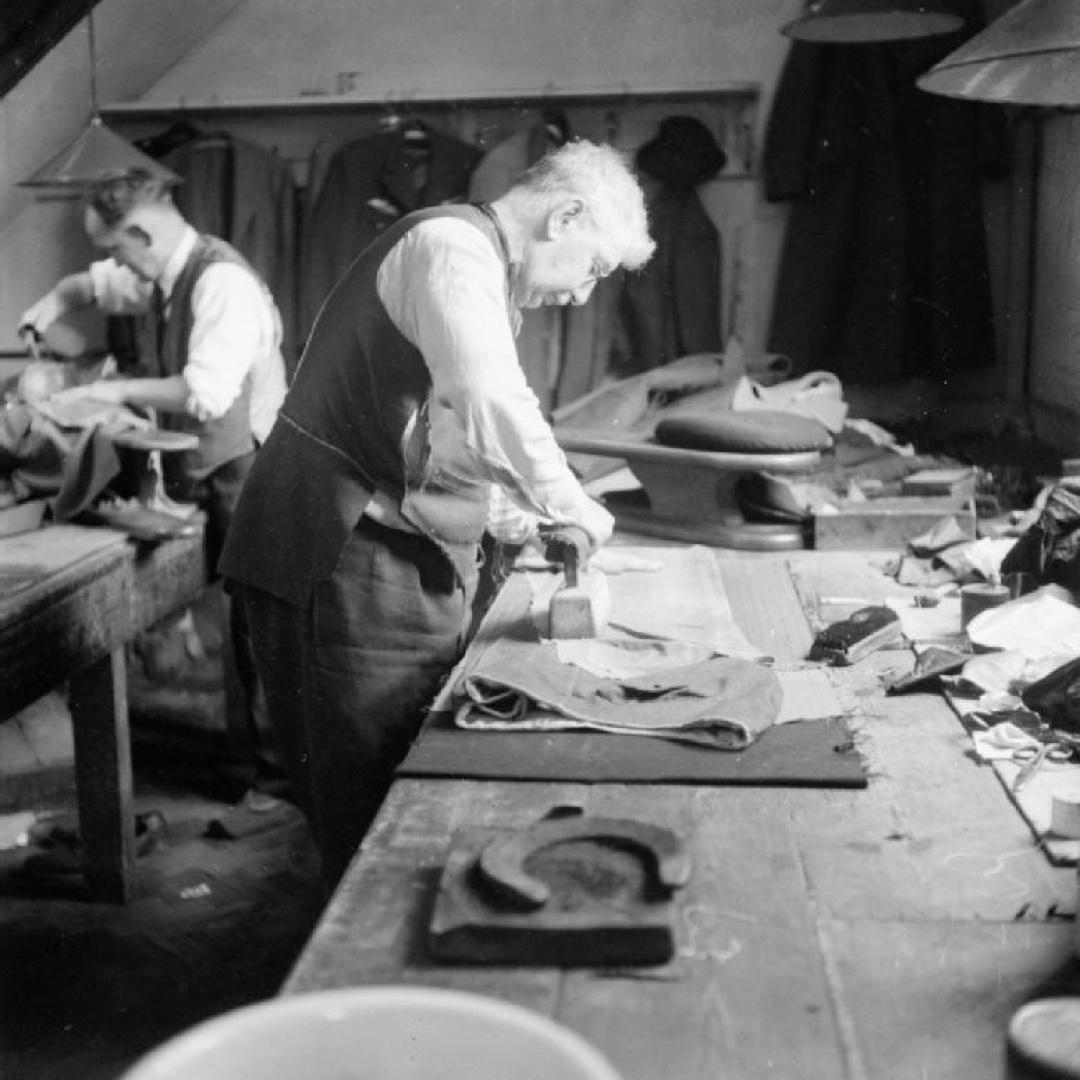
A tailor presses a seam with a heavy iron in the Henry Poole workroom on Savile Row, 1944 (public domain)
Say "Savile Row" anywhere in the world and people think of a well-cut suit. Yet when the street was laid out in the 1730s, nobody planned it for tailors. It was built as a smart address for the officers, politicians and gentlemen who wanted to live near Piccadilly. The tailors came a century later, and they came because their customers were already there.
Lord Burlington's street
Savile Row was built between 1731 and 1735 as part of the Burlington estate, the land behind Burlington House on Piccadilly. It took its name from Lady Dorothy Savile, wife of the 3rd Earl of Burlington, and for its first decades it was called Savile Street. A newspaper notice of 1733 announced the new buildings under that name, and the ratebooks only settled on Savile Row in 1810.
Lord Burlington was a serious patron of architecture, and the street showed it. Henry Flitcroft was the main architect, and William Kent, the designer behind much of the Palladian taste of the age, designed several houses and held the lease of No. 2. The first occupant of No. 1, Bryan Fairfax, a Commissioner of Customs, moved in early in 1733.
Officers, politicians and a playwright
The first residents were mainly military officers and their wives, along with politicians. William Pitt the Younger wrote letters from Savile Street. The playwright Richard Brinsley Sheridan lived at No. 14 from 1813 until his death in 1816, and Jules Verne later gave his fictional traveller Phileas Fogg a home at No. 7. From 1870 to 1912 the Royal Geographical Society occupied No. 1, where expeditions to Africa, Asia and the South Pole were planned, and where David Livingstone lay in state before his burial in Westminster Abbey.
A street full of officers and gentlemen was a street full of men who needed uniforms, coats and evening clothes. It was only a matter of time before the men who made them moved in next door.
The tailors arrive
Tailors began to settle in the area in the late eighteenth century, first on nearby Cork Street around 1790, and on Savile Row itself by 1803. The name most closely tied to the street's rise is Poole. James Poole began as a military tailor during the Napoleonic Wars, making uniforms for officers, and later took premises in Old Burlington Street, which backs onto Savile Row.
After James died, his son Henry made the decisive move. In 1846 Henry Poole opened an entrance onto Savile Row from his late father's premises, and the firm went on to build up its buildings there over the following decades. Henry Poole & Co. calls him the founding figure of Savile Row, and its archive holds ledgers going back to 1846. Others followed, among them H. Huntsman & Sons, founded in 1849, which moved to No. 11 Savile Row after the First World War. By the middle of the twentieth century around forty tailors worked in and around the street.
The dinner jacket
Poole's customers included the Prince of Wales, later Edward VII. According to the firm's history, in 1860 Henry Poole made the prince a short evening jacket to wear at informal dinners at Sandringham. The story goes that an American guest, James Potter of Tuxedo Park in New York, had one made by Poole's in the 1880s and wore it home to the Tuxedo Club, where the other members copied him. In Britain it became the dinner jacket. In America it became the tuxedo.
War and change
Savile Row did not escape the Blitz. In September 1940 a raid damaged the police station on the corner of Boyle Street and destroyed No. 21a, and No. 7 had been destroyed earlier the same month. Photographs taken in 1944 show tailors at work in the Poole workroom while a gap stood where houses had been. In 1961 Poole's left Savile Row for Cork Street. The firm is now back on the street at No. 15, still run by the Cundey family, descendants of Samuel Cundey, the cousin who took over the firm when Henry Poole died in 1876.
The street kept reinventing itself. Nutters of Savile Row opened on Valentine's Day 1969 and brought a younger, bolder cut, and the Beatles played their last live performance on the roof of No. 3 on 30 January the same year. In 2004 the Savile Row Bespoke Association was founded to protect the craft.
The meaning of bespoke
The word "bespoke" is understood to have come from Savile Row, where it came to mean a suit cut and made by hand for one man. Nearly three centuries after Lord Burlington laid out his street, that idea still holds: the best-dressed man is the one whose clothes, and whose grooming, have been made to suit him.