
The Coffee Houses That Made the London Gentleman
For a penny, a seventeenth-century Londoner could buy a dish of coffee and a seat at the table. Out of those rooms came Lloyd's, the Stock Exchange and the gentlemen's club.
By The London Grooming Company
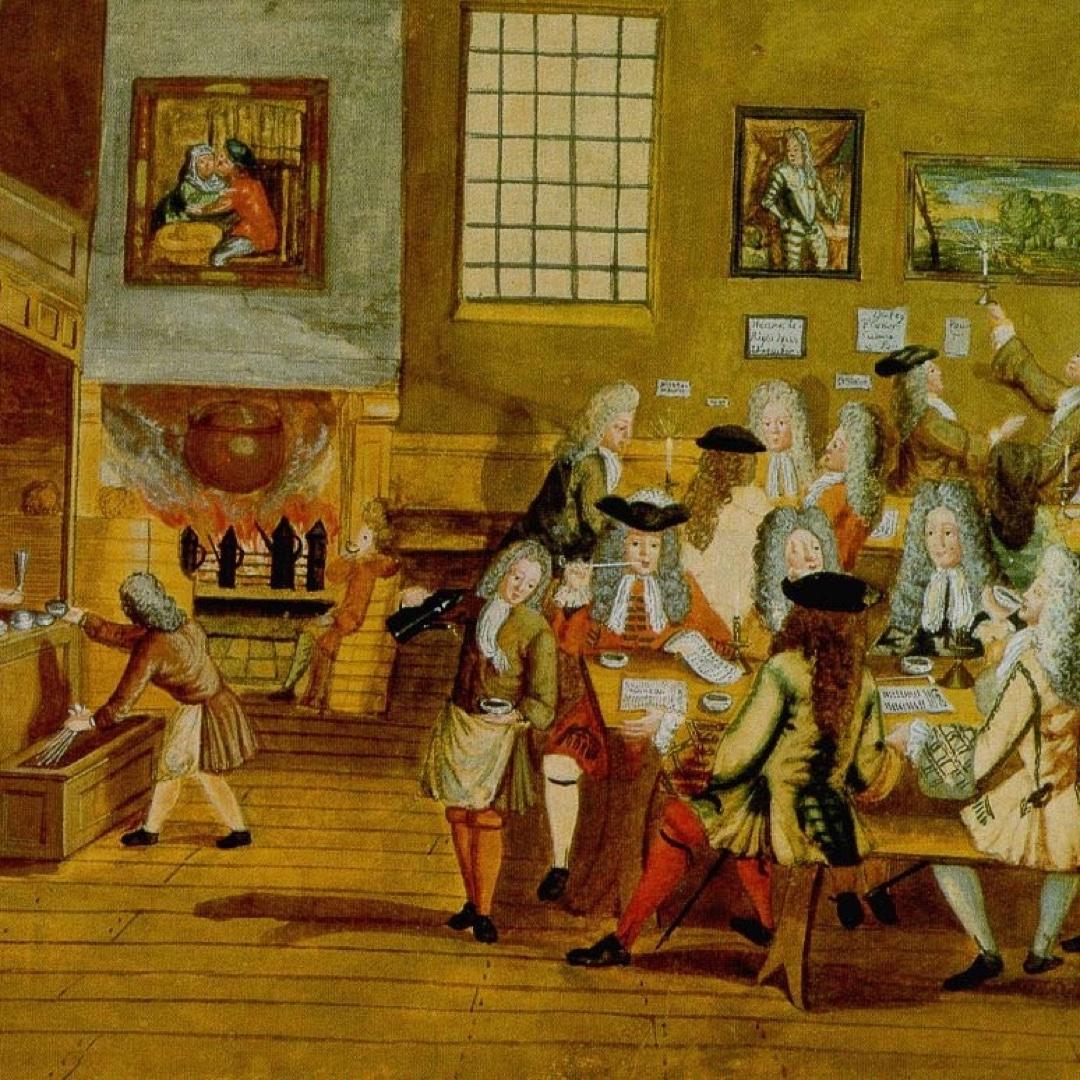
Interior of a London coffee house in the late seventeenth century, men in wigs reading and talking at long tables (public domain)
Before there were clubs on St James's Street, there were coffee houses in the City. In the second half of the seventeenth century, a man who wanted the news, a deal, an argument or simply a warm room could find all four for the price of a dish of coffee. Those smoky rooms did more than anywhere else to shape the London gentleman: how he talked, where he did business and, in time, where he went to belong.
A servant from Smyrna
England's first coffee house opened in Oxford in 1650, at the Angel coaching inn. London followed two years later. Pasqua Rosée had been the servant of Daniel Edwards, an English merchant of the Levant Company in Smyrna, and had made Edwards his coffee every day. When the two came back to London at the end of 1651, Edwards set Rosée up in a coffee house in St Michael's Alley, off Cornhill, close to the Royal Exchange. In 1652 Rosée printed a handbill, The Vertue of the Coffee Drink, promising his customers all manner of health benefits.
The wooden buildings in St Michael's Alley burned in the Great Fire of 1666. A Victorian building now stands on the site, today the Jamaica Wine House, and in 1952 the Lord Mayor unveiled a plaque there to mark three hundred years since Rosée's first cup.
A penny for a seat
Coffee houses spread quickly because they were cheap and open. Admission cost a penny, and a poem from 1672 made the point that a man could become a scholar for the price of one. Once inside, rank mattered less than conversation. Merchants sat beside writers, and newspapers lay on the tables for anyone to read. Whether women were welcome as customers is still argued over by historians, but the rooms were overwhelmingly male, and a 1674 pamphlet, The Women's Petition Against Coffee, made a comic complaint about what the drink was doing to their husbands.
Not everyone in power liked what was said there. On 29 December 1675 Charles II issued a proclamation for the suppression of coffee houses, due to take effect in January. The outcry was such that the order was withdrawn before it could be enforced, and the coffee houses carried on.
Lloyd's and the business of risk
Some coffee houses became known for one kind of customer. Edward Lloyd's, on Tower Street near the river, drew merchants, ship owners and sailors, and the first reference to it appears in the London Gazette in 1688. Shortly after Christmas 1691 Lloyd moved to 16 Lombard Street, where a blue plaque marks the spot. The house published lists of shipping movements, and the men who met there to share the risk of a voyage became underwriters. In the 1770s they left the coffee house for rooms at the Royal Exchange as the Society of Lloyd's, and the name has stayed with the London insurance market ever since.
Jonathan's and the Stock Exchange
A few streets away, in Change Alley, Jonathan Miles opened his coffee house around 1680. By the 1690s it was one of the places where stockbrokers could be found and share prices learned, and from 1698 John Castaing posted a list of prices there under the title The Course of the Exchange and Other Things. In 1773 the brokers built their own premises in Sweeting's Alley, which they called New Jonathan's. It went on to become the London Stock Exchange.
From chocolate house to club
Coffee was not the only fashionable drink. In 1693 an Italian, Francesco Bianco, opened Mrs White's Chocolate House in Mayfair. Its regulars made it their own, and over the following century it turned into something new: a private club, with members, rules and a famous betting book. White's moved to 37 to 38 St James's Street in 1778 and is still there, the oldest gentlemen's club in London.
Others followed it into St James's, and the clubs gradually took over much of what the coffee houses had done: a place to read the papers, talk politics and be among friends. Some of the old houses changed trade instead. In 1706 Thomas Twining opened a tea room at 216 Strand, and his firm still trades from the same address.
What the coffee house left behind
By the end of the eighteenth century the coffee house had largely faded from English life, as tea took its place. What it left was a type: the London gentleman who reads the paper, keeps up with the news, knows where to find his friends and takes some care over how he presents himself when he gets there. The rooms have changed. The habit of turning out properly for good company has not.