
The Cut-Throat Razor and Sheffield Steel
Before the safety razor, every gentleman's shave depended on a blade, a strop and a steady hand. Most of those blades came from Sheffield.
By The London Grooming Company
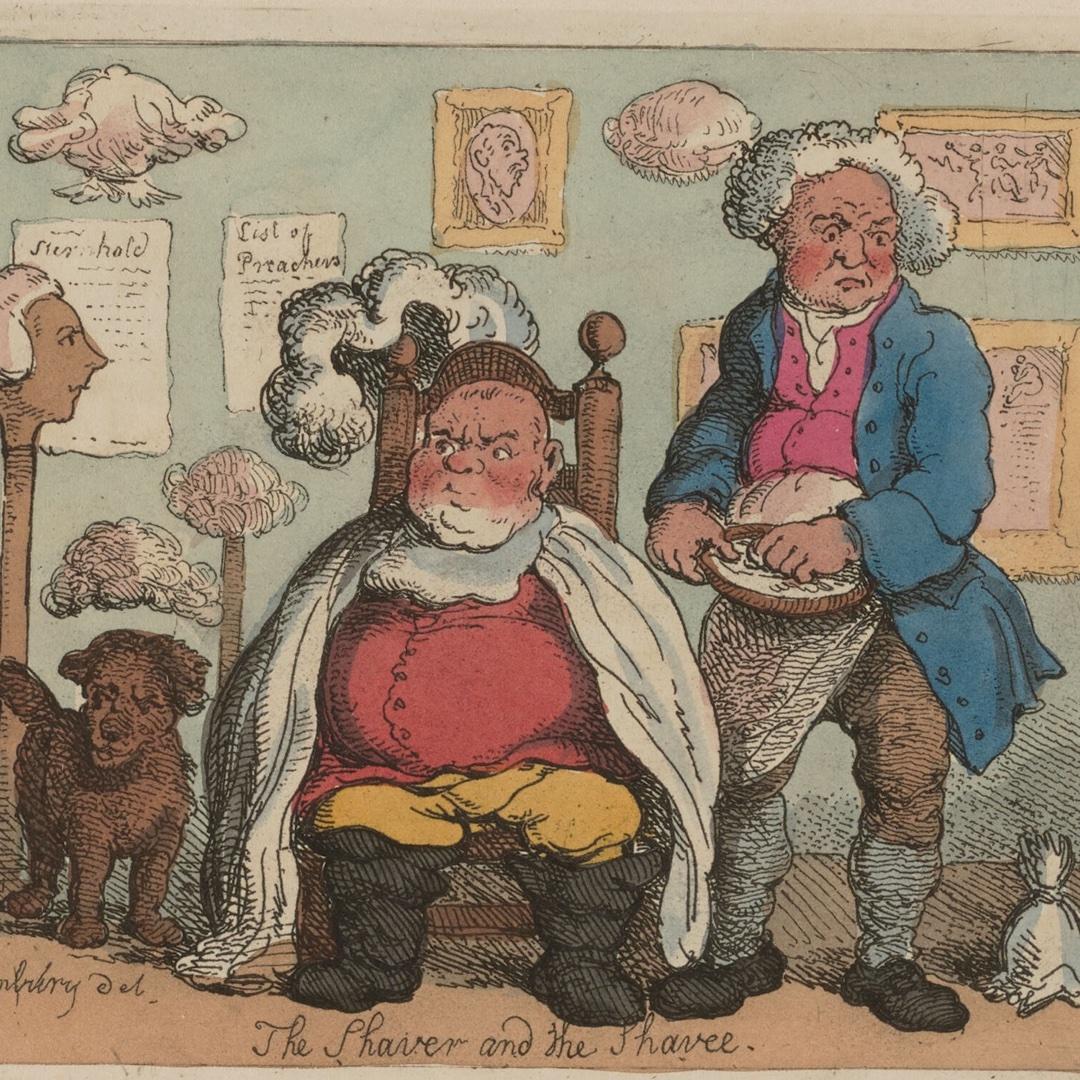
The Shaver and the Shavee, hand-coloured print by Thomas Rowlandson after Henry Bunbury: a barber lathers a seated customer (public domain)
For most of London's history, a clean shave meant an open blade held against the throat. Whether a gentleman shaved himself at the washstand or sat back in a barber's chair on Jermyn Street, the tool was the same: a straight razor, known in England as the cut-throat. And the steel in that razor, more often than not, had come from Sheffield.
Sheffield's long trade
Sheffield's reputation for blades is very old. A tax return of 1297 names a "Robert the Cutler", the earliest surviving reference to cutlery making in the town. Around 1387 Chaucer gave the miller in The Reeve's Tale a "Sheffeld thwitel", a small Sheffield knife, carried in his hose. By 1624 the trade was important enough for an Act of Parliament to create the Company of Cutlers in Hallamshire to oversee it, and the company has met in its hall on Church Street, opposite the cathedral, since 1638. It has held an annual feast to show off the town's industry since 1625.
Huntsman's steel
A razor is only as good as its steel, and in the eighteenth century Sheffield gained a decisive advantage. Benjamin Huntsman, born in 1704, started out as a clock, lock and tool maker in Doncaster. He began experimenting with steel there, and in 1740 he moved to Handsworth, near Sheffield, where he made cast steel by melting it in clay crucibles. The result was harder and more even than anything available before.
At first the Sheffield cutlers would not buy it, because it was harder to work than the German steel they were used to. So Huntsman sold almost everything he made to France. When French cutlery made from his steel began to appear, the Sheffield cutlers tried to have the export banned, failed, and started using it themselves. Huntsman never patented the process, and a Sheffield ironfounder named Walker eventually worked out his secret. In 1770 Huntsman moved his works to Attercliffe, where he stayed until his death in 1776, and his son William carried on the business. By 1740, according to one account, he was also making razors with hollow-ground blades of his cast steel.
The blade and its care
A cut-throat razor asked a lot of its owner. The finest blades were hollow ground: the sides were ground concave, leaving a thin, flexible edge that many barbers preferred. That edge needed constant attention. Before each shave it was stropped on leather to straighten it, and every so often it was honed on a stone to restore it. A gentleman who looked after his razor could keep it for years.
The shave itself was a ritual. The face was softened with hot water, lathered with a brush, and shaved with the grain and then across it, with the skin held taut. Thomas Rowlandson's print The Shaver and the Shavee, published in 1808 after a drawing by Henry Bunbury, shows the scene as Londoners knew it: the customer in his chair, the barber with his bowl, wigs on stands around the walls.
The safety razor arrives
The open blade had challengers long before it lost. A guard razor was probably invented in France around 1762, and in 1847 William Henson filed a patent for a hoe-shaped razor with a comb-like guard. In 1880 the Kampfe brothers in America patented a "safety razor" under the Star brand. The decisive change came from King Camp Gillette, whose double-edged razor with throwaway blades was patented in 1904. During the First World War his company supplied American troops with 3.5 million razors and 32 million blades, and many men never went back.
Sheffield had one more contribution to make. In 1913 Harry Brearley, working at the Brown Firth Laboratories in the city, invented stainless steel. Even so, the straight razor stayed in common use until the middle of the twentieth century, and in barbers' shops it never really went away.
Where to see it
Sheffield's tools are well kept. The Hawley Collection, gathered by the Sheffield tool dealer Ken Hawley, now lives at Kelham Island Museum and runs to more than 70,000 tools, among them the work of the town's razor makers and grinders.
What hasn't changed
Whatever is in your hand, the principles of a good shave are the ones the old barbers knew: warm water, a proper lather, a sharp edge and calm skin afterwards. Our shave cream and aftershave balm are made in England for exactly that.