
The Turkish Baths of Victorian London
In 1860 London had no Turkish baths. Within a few years there were dozens, and the grandest of them, the Hammam on Jermyn Street, was called the finest in the world.
By The London Grooming Company
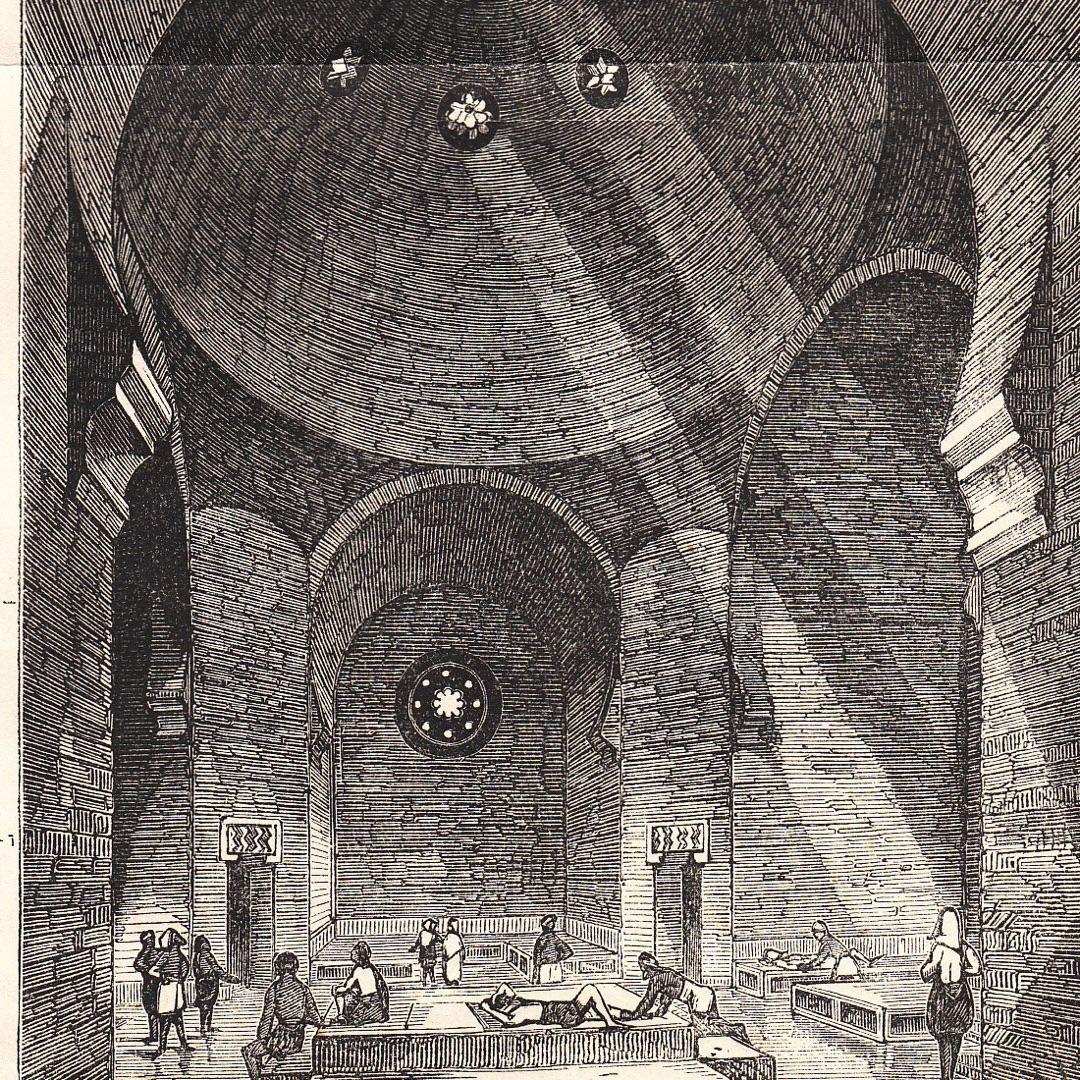
Engraving of the domed hot room of the Hammam on Jermyn Street, with shafts of light falling on bathers, about 1861 (public domain)
In the spring of 1860 there was not a single Turkish bath open to the public in London. By the end of the century the city had seen more than a hundred. For a few decades, the Victorian gentleman's idea of getting properly clean meant an afternoon of hot dry air, a vigorous scrub and a long rest in a cooling room, and the grandest place to do it was on Jermyn Street.
An idea from the East, by way of Ireland
The craze began with a book. In 1850 the diplomat David Urquhart published The Pillars of Hercules, an account of his travels, with two chapters on the bathhouses he had used in Morocco and Turkey. In 1856 it was read by Dr Richard Barter, who ran a hydropathic establishment at St Ann's, near Cork. Barter offered Urquhart men, money and materials to build a bath there.
The first attempt, a beehive-shaped steam room, failed because it could not be made hot enough. Barter's architect then studied the ancient baths of Rome and designed something new: a bath of hot, dry air rather than steam. This became the Victorian Turkish bath. In 1857 Urquhart helped build one in Manchester, and he insisted on calling it a Turkish bath, though others preferred "Irish" or "Roman".
A shilling in Bell Street
London's first came about almost by accident. Roger Evans, a long-standing sufferer from neuralgia, had been converted to the bath at Urquhart's home near Rickmansworth. Around the beginning of April 1860 he built one in his house in Bell Street, just off the Edgware Road, and opened it to fellow working men at a shilling a time. A brick flue heated the hot room to 160°F.
By September 1860 Evans had opened a larger bath in Golden Square, and others appeared across the city. In February 1861 the writer George Jacob Holyoake remarked that Turkish baths were spreading "like asteroids in November". Over the following decades more than a hundred opened in London, with more than twenty-five companies formed to build or run them, and by the mid-1870s they could be found in hotels, hospitals and some private houses.
The Hammam
The finest of them all was the London Hammam at 76 Jermyn Street, built by Urquhart's London and Provincial Turkish Bath Company on the site of the old St James's Hotel. The architect, George Somers Clarke, agreed to work under Urquhart's supervision, and Urquhart himself acted as the company's first manager. Early plans for a four-storey building were scaled back to two floors when they proved too costly, but the centrepiece survived: a great domed hall, lit by small star-shaped openings in the roof.
The Hammam opened to its directors and friends on 16 July 1862 and to the public on 28 July. Several of Queen Victoria's sons were among its customers, and admirers called it the finest Turkish bath in the world. Anthony Trollope used it too, and set his short story The Turkish Bath there.
What a visit involved
A visit to a Victorian Turkish bath was slow by design. Bathers moved through a series of rooms, each hotter than the last, until they were sweating freely. Then came washing and a thorough shampooing, which in Victorian usage meant a full-body massage and scrub. Last of all, wrapped in towels, they rested in a cool room before dressing and going back out into the street.
A scent and a street
The Hammam left its mark on Jermyn Street in another way. In 1870 the barber William Penhaligon set up shop on the street, and in 1872 he created his first fragrance, Hammam Bouquet, which his house describes as a tribute to the scent of the Turkish baths next door.
The end of the craze
Fashions changed, and the great baths slowly closed. The Hammam shut its doors just before the end of 1940, and on 17 April 1941 it was destroyed in the Blitz. Of the few Victorian Turkish baths still open today, none is in London.
The ritual itself has outlasted the buildings. Heat, a proper exfoliation and a long cool rest still leave skin feeling cleaner than any quick wash. At home, a weekly face scrub followed by a good moisturiser is the modern, rather quicker, version.